Description
Armenian chant is a monophonic, melismatic vocal tradition used in the liturgies of the Armenian Apostolic Church and the Armenian Catholic Church. A single melodic line carries the sacred text, with passages in which several notes are sung to a syllable.
Its melodies are organized into eight modes, known collectively as the oktoechos. These modes have no direct equivalents in the Western modal tradition, though they show a notable similarity to the Byzantine scale also called the double harmonic scale. Classical Armenian, or grabar, is the language of the early canonical hymns.
History
Early hymns
The earliest Armenian chants are attributed to St. Mesrop Mashtots in the 5th century. The invention of the Armenian alphabet and the translation of the Bible encouraged the creation of hymns distinct from those of neighboring Christian communities. Mashtots and Catholicos Partev composed chants that drew in part on pre-Christian Armenian melodies. The hymns circulated orally before being recorded in notation.
Hymn collections and notation
Compilation of the Sharaknots, a collection used for Sunday liturgy and feast days, began in the 1300s and continued into the early 1400s. The earliest surviving Armenian liturgical manuscripts with musical notation date from the 8th century. Their signs, known as khaz, indicate pitch changes above the words. The notation evolved, but much of it later became unreadable as knowledge of the system was lost.
Later work
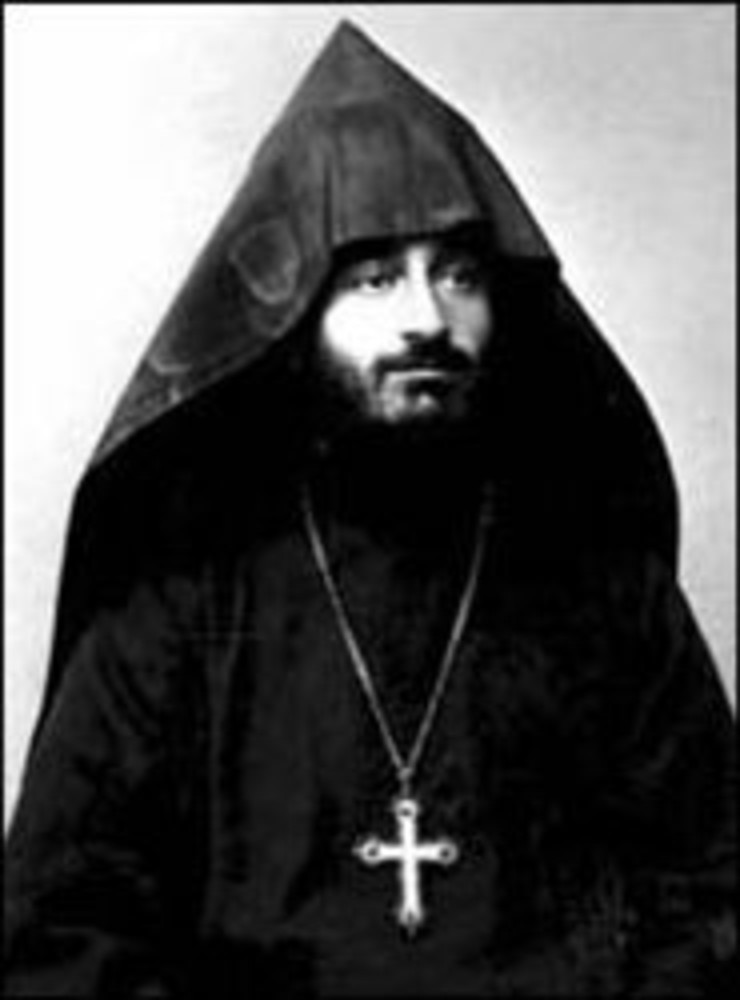
In the first half of the 19th century, Hamparsum Limonciyan introduced a new Armenian notation. Later in the century, Komitas Vartabed studied oral traditions and manuscripts in an attempt to decipher the older neumes. He did not complete the project, but surviving works of his have been incorporated into the Armenian liturgy.
Text and melodic line
Begin with a sacred text intended for a liturgical setting. Build a single unaccompanied melodic line around the words rather than relying on harmony. Give important syllables extended melismas, while leaving other parts of the text clearer and more direct; sing the result aloud to test how naturally the words and melody fit together.
Mode and movement
Choose a modal framework and give its principal tones a clear role. You could establish a recurring reciting tone, then shape rises and falls in relation to it. The Armenian system has eight modes, so studying examples in a particular mode is more useful than simply substituting a Western scale. Keep the relationship between the melodic contours and the text audible throughout.
Notation and revision
Sketch the words first and mark melodic movement over or alongside them. Western notation can serve as a practical working draft; listening and singing revisions can help refine the phrasing and the longer ornaments.