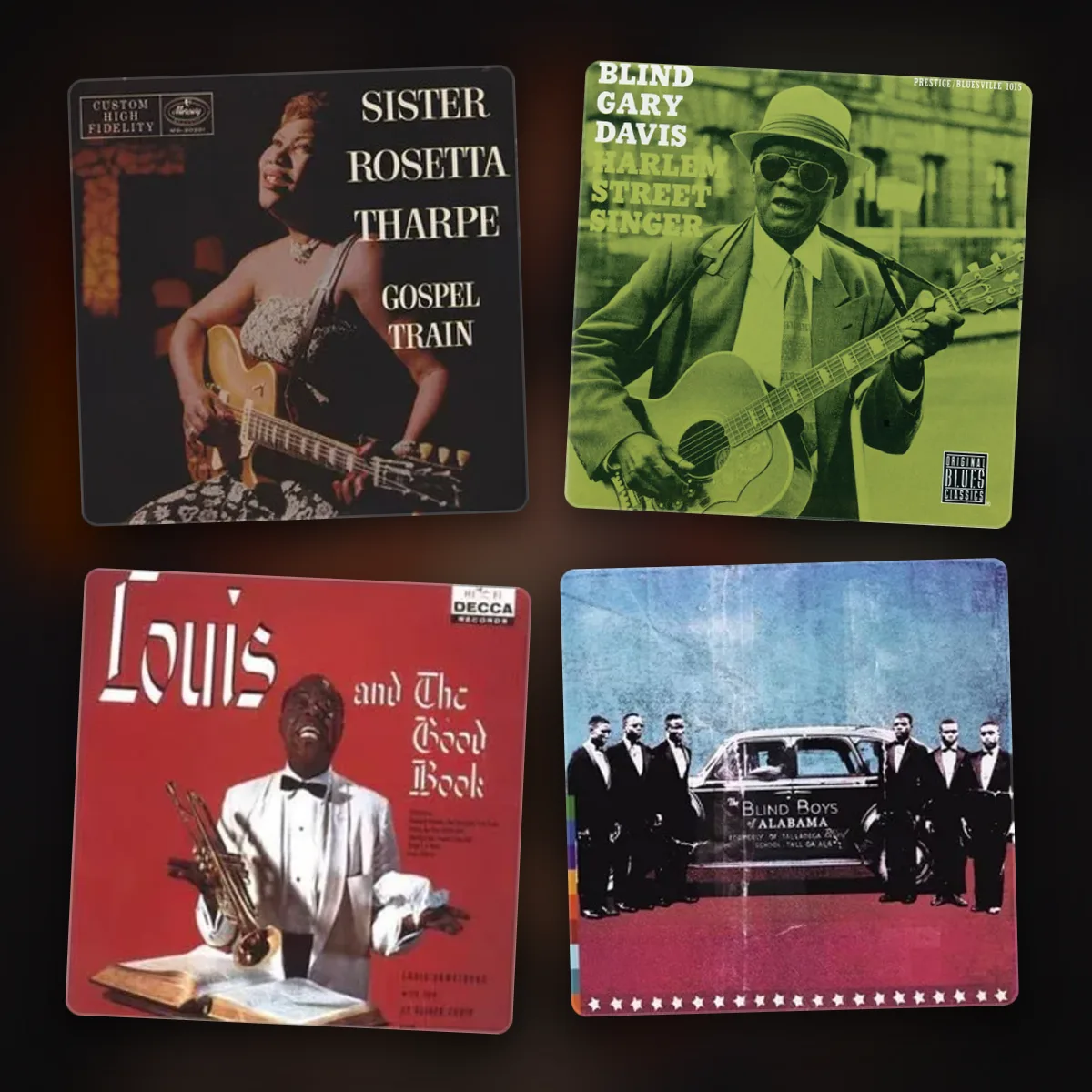
Description
Gospel hymn is a Protestant hymn tradition shaped for communicating the Christian gospel. Its language tends to be direct and accessible, often speaking from a first-person perspective, while its emotional immediacy reflects the influence of earlier camp meeting songs.
The tradition includes different approaches to performance. One stream drew particularly on African-American spirituals and worship practices, incorporating keyboard accompaniment, hand-clapping and improvisation. Gospel hymns continue to be sung in American Protestant services, sometimes alongside or blended with newer gospel and contemporary Christian music styles.
Based on: Rate Your Music
More on: MusicBrainz
History
Revival roots
Gospel hymns emerged in the United States in the mid-19th century from a Protestant hymn tradition influenced by the songs of revival camp meetings. Those meetings brought together Anglo-American folk music and African-American musical traditions; their songs passed orally before being gathered into hymnbooks. By the end of the century, gospel hymns had become a dominant form of American hymnody among both Black and white congregations.
Publication and evangelism
During the 1860s and 1870s, white evangelists began composing and publishing gospel hymns for an increasingly urban revival movement. Fanny Crosby was an early pioneer whose lyrics began appearing in print in 1864. Philip Bliss and Ira Sankey were known as both singers and writers and collaborated with Crosby. Sankey and the evangelist Dwight L. Moody published Sacred Songs and Solos in 1873; the associated style is often called the Moody-Sankey hymn. William Bradbury, James McGranahan and Daniel Webster Whittle were other notable hymn writers of the period.
African-American developments and later life
Around the turn of the 20th century, Black Methodist minister Charles Albert Tindley pioneered an approach drawing more directly on African-American folk traditions, including the spiritual. His hymns addressed oppression after slavery and the experience of movement toward Northern cities. This stream helped shape traditional Black gospel through its use of African-American worship practices and keyboard accompaniment. Gospel hymns have remained part of Protestant worship, with new examples continuing to be written into the 21st century.
Start with the words
Write a hymn that communicates a Christian gospel message in simple, direct language. A first-person perspective can give the text the personal, emotionally immediate quality associated with the tradition. Make the words clear enough to be understood when sung.
Shape a singable setting
Set the text as a hymn rather than treating it solely as a spoken message. You could use a recurring melodic pattern to help a congregation learn the words, or add a refrain that reinforces the central idea. Keep the relationship between melody and text clear, allowing the natural emphasis of the words to guide the phrasing.
Choose an approach to performance
For an approach drawing on the African-American stream of gospel hymnody, consider keyboard accompaniment, hand-clapping and room for vocal improvisation. These can be used to support the message and give the performance a more responsive, expressive character. Alternatively, a simpler vocal setting can keep attention on the hymn text.




Best playlists
Influenced by