Description
Hyper techno is a fast, riff-led form of techno derived from Belgian techno. Its distinguishing profile is an accelerated pace and a foregrounded use of riffs built from samples and synthesizer sounds associated with 1990s dance music.
It is closely aligned with Eurobeat in setting and historical trajectory, functioning as a techno-side counterpart rather than simply conventional techno played faster. Its later sound incorporates a broad, rave-oriented dance vocabulary, while its contemporary identity is strongly tied to an affectionate, high-energy recall of 1990s club music.
Based on: Rate Your Music
More on: Discogs, MusicBrainz, Wikidata
History
Beginnings
Hyper techno’s history began in 1992 through two independent currents. One involved Eurobeat producers Andrea Leonardi, known as Bratt Sinclaire, and Alberto Contini, known as A.C. Wild and as the frontman of Bulldozer. Their experiment combined then-fashionable Belgian techno with forms of extreme metal; it produced “Dance Got Sick Part Three” on the Dance Got Sick! Trilogy record.
Japanese development
A second current arose alongside Japan’s techno boom, connected with the Japanese release of “James Brown Is Dead” and music played at Juliana's Tokyo. In Japan, hyper techno was quickly reconceived as an accelerated, hypertrophied Belgian-techno form for rave culture, analogous to Eurobeat’s relationship with Italo-Disco.
Club, game, and dance contexts
As Belgian techno was displaced in Europe during the mid-1990s, hyper techno became highly popular in Japan. It became a principal sound of Japanese nightclubs for a period and a traditional genre in Bemani rhythm games including Dance Dance Revolution and beatmania. It also generated TechPara, a ParaPara-derived dance variant performed mainly to hyper techno and Eurodance.
Later profile
Over time, the style absorbed elements from several rave and dance forms. It is now commonly understood as a tribute-minded continuation of 1990s club-music language.
Pulse and structure
Begin with a very fast, insistent dance pulse. A steady four-on-the-floor kick is a practical foundation; keep the groove direct enough for rave dancing, then create momentum through short fills, abrupt transitions, snare builds, and repeated sections that intensify rather than drift.
Riffs and sound design
Make the central hook a compact, memorable synth or sampled riff. Use bright, assertive 1990s-style dance timbres: sharp stabs, buzzy lead sounds, synthetic brass-like hits, hoovers, or chopped vocal fragments. Layer the riff with a firm bass part, but leave sufficient space for the hook to remain immediately recognizable.
Harmony and arrangement
Favor short harmonic loops and clear tension-and-release changes. Introduce the main motif early, remove drums or bass briefly before a return, and vary the hook by octave, filtering, rhythm, or sampling treatment. Keep the arrangement energetic and economical rather than harmonically dense.
Vocals and finish
Lyrics can be minimal: repeated commands, sampled exclamations, and short English-language dance phrases can function as rhythmic material. Mix for impact: a solid kick and bass center, crisp percussion, controlled distortion on aggressive elements, and a bright top end that preserves the speed and excitement of the riffs.

HOW TO HYPER TECHNO🔥 #houseproducer #producer #housemusicproducer #flstudioproducer
Jorm

How To Hypertechno Bass In Serum 🔥 #shorts #hypertechno #musicproduction #flstudio #sounddesign
Sonance Sounds

How To Make a Hypertechno Remix From Scratch [FL Studio Tutorial]
Sonance Sounds
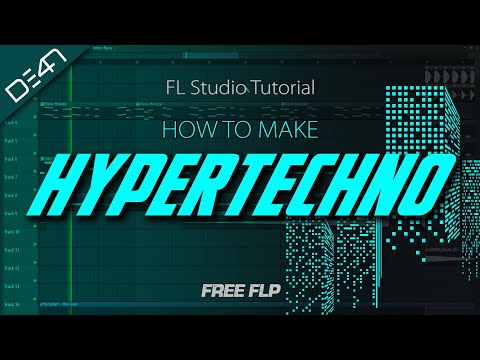
HOW TO MAKE HYPERTECHNO - FL Studio Tutorial (+FREE FLP)
D34N

Top albums


Best playlists
Hyper Techno
Melodigging

The Sound of Hypertechno
Every Noise at Once
Hypertechno
Chosic

Hypertechno Mix
Spotify

Macon pres. HYPERTECHNO (Part 2) [50min DJ Mix]
Macon
Influenced by




Other similar genres
Genres sharing the most artists with Hyper Techno